
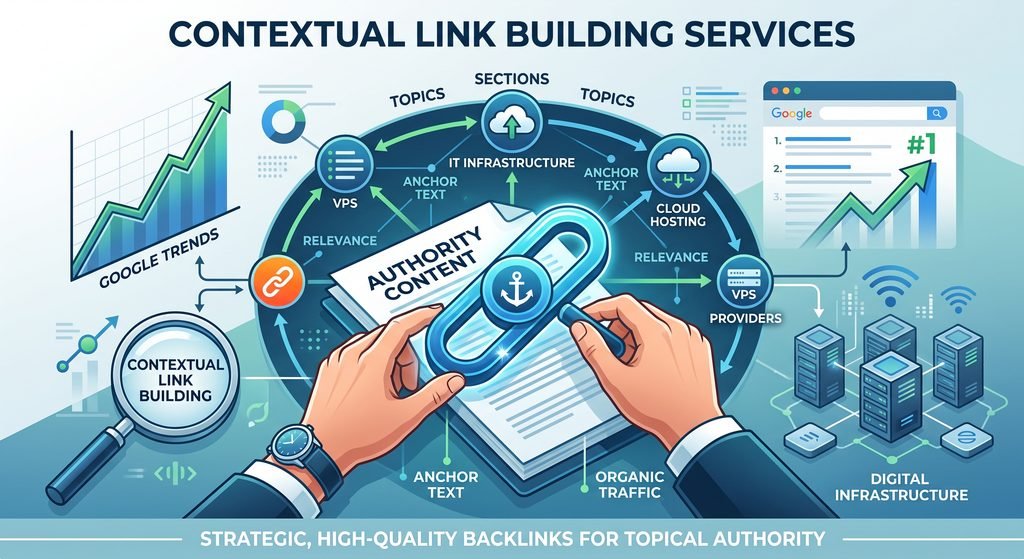
Why Contextual Link Building Services Are Dominating SEO in 2026 (And How I Do It)
If you have been keeping an eye on Google Trends recently, you’ve likely noticed a sharp, undeniable uptick in interest surrounding “contextual link building services.” For years, the SEO industry treated link building as a volume-driven numbers game. If you had the most backlinks, you won. But as search engine algorithms have grown more sophisticated, leveraging AI and natural language processing to understand the true intent behind content, the landscape has shifted dramatically. Today, acquiring backlinks is no longer about brute force; it is about combining domain authority with multi-layered, semantic relevance.
Over my career managing digital link-building outreach for complex B2B sectors—specifically IT infrastructure, virtualization, and cloud hosting platforms—I’ve seen firsthand how a strategic, highly relevant contextual link can make or break a domain’s organic visibility. Whether I’m analyzing domain relevance for enterprise VPS providers or preparing outreach strategies for a new product launch, the fundamental truth remains the same: a link is only as powerful as the context surrounding it.
In this article, I want to pull back the curtain on my personal methodology, share advanced tips and tricks, and explain exactly why contextual link building is the most critical off-page SEO strategy you can deploy today.
What Are Contextual Backlinks (Really)?
There is a common misconception in the digital marketing world that any hyperlink placed inside the body of an article is automatically a “contextual link.” Unfortunately, in-content placement is just the starting point, not the finish line. True contextual link building is the practice of earning backlinks embedded seamlessly within content that is genuinely, semantically relevant to the page being linked to.
To pass the test of modern search engine algorithms, a high-quality contextual backlink must satisfy four distinct layers of relevance:
- Domain-Level Relevance: The linking website covers topics broadly related to your industry. For example, getting a link from a generic lifestyle blog to a cloud computing site carries little weight. The linking domain should ideally be a tech blog, a software review site, or an IT news portal.
- Article-Level Relevance: The specific article topic must be directly aligned with your target page. A broad technology site might have an article about smartphone screens; placing a link to a server hosting provider there makes zero contextual sense.
- Paragraph-Level Relevance: The exact surrounding sentences must logically explain, support, or introduce why the linked page is useful to the reader. The transition must feel entirely natural to a human reader.
- Placement Relevance: The link lives natively inside the main editorial content. Links buried in author bios, sidebars, or footers do not carry the same “contextual” weight as those placed high up in the body of a well-researched paragraph.
When these four layers perfectly align, search engines receive incredibly strong signals about your page’s topical authority, which directly translates to improved keyword rankings, referral traffic, and long-term brand credibility.
My Experience: Link Building in the Cloud Hosting Space
In my daily outreach work, I don’t just hunt for high Domain Rating (DR) metrics on Ahrefs or Moz. I specialize in contextual anchor text optimization and backlink strategy for highly technical, competitive niches.
Recently, I was conducting extensive domain relevance scoring, backlink suitability analysis, and anchor text evaluation for domains like netrouting.com, buyvps.com, and prefixx.net. In these enterprise infrastructure spaces, you cannot fake relevance. I had to ensure that our contextual links didn’t just look good on an SEO spreadsheet, but actually made logical sense to a network engineer reading the article.
For instance, in September 2026, I prepared a detailed freelancing proposal targeting backlink acquisition for a newly launched domain, cloudstage.cloud. The objective was to secure USA-hosted, high-quality backlinks. In this scenario, a link from a generic startup blog isn’t enough to move the needle. I needed to secure placements within deep-dive articles discussing cloud scalability architecture, bare-metal server infrastructure, or enterprise data center management. That precise alignment—matching technical content with technical target pages—is what drives actual organic growth and survives algorithm updates.
Core Strategies for Contextual Link Acquisition
When executing a high-level contextual link building service, you need a diverse mix of strategies to create a natural, unshakeable backlink profile. Here are the core methods I rely on:
1. Strategic Niche Edits (Link Insertions)
Link insertions into relevant, existing, and aged articles are incredibly effective because the page has already been indexed and has proven its ability to rank. My approach involves finding pages ranking for topics related to my target page, verifying their organic traffic, and identifying a specific paragraph where my link adds genuine, missing value. Pitching the editor with the exact suggested sentence placement usually yields the highest success rates because you are doing the heavy lifting for them.
2. Authority-Driven Guest Posting
Guest posting remains a powerhouse strategy, provided you target niche-relevant websites and prioritize quality over quantity. The key is to match the website’s audience and provide original insights, data, or industry predictions. I frequently draft outreach emails to site administrators specifically inquiring about their guest post editorial guidelines and advertising rates. My goal is to ensure our content avoids keyword stuffing and only links out when it directly helps the reader solve a problem or learn a concept.
3. Digital PR and Resource Page Link Building
In technical niches, resource pages are goldmines. Many universities, open-source communities, and IT organizations maintain lists of helpful tools and guides. Reaching out to suggest an in-depth, highly technical guide we’ve created (like a “Complete Guide to VPS Security“) as an addition to their resource page is a highly contextual, white-hat way to earn authoritative links.
My Top Tips and Tricks for Mastering Link Outreach
Over years of sending thousands of outreach emails and negotiating with site owners, I’ve developed a few tricks that drastically improve acceptance rates and link quality.
- Tip 1: The “Give Before You Ask” Method: Webmasters are bombarded with automated link requests daily. Stand out by offering value first. Point out a broken link on their site, share their article on your active social media channels, or offer a genuinely helpful piece of feedback before ever asking for a link insertion.
- Tip 2: Natural Anchor Text Ratios: Anchor text must be handled with extreme care. Repeating the exact same keyword (e.g., “best cloud hosting”) across dozens of backlinks makes a profile look unnatural and manufactured, risking a Google penalty. The anchor text should emerge naturally from the surrounding sentence. I use a healthy mix of descriptive phrases, such as “contextual SEO links” or “evaluating server infrastructure,” alongside branded terms (e.g., “Prefixx’s solutions”) and naked URLs.
- Tip 3: The “Traffic Check” Rule: Never acquire a contextual link on a site with zero organic traffic. I always run the prospective domain through an SEO tool to ensure its traffic graph is stable or growing. A site that has lost 90% of its traffic in a recent core update is toxic, regardless of its legacy Domain Authority.
- Tip 4: Customize Your Outreach Footprint: I never use stock email templates. When reaching out regarding IT links, I mention specific industry nuances. Personalization isn’t just inserting a {First_Name} tag; it’s proving you actually read the article you are asking to be linked from.
- Tip 5: Negotiate Paragraph Placement: When paying for an administrative or editorial fee for a link insertion, insist that the link is placed in the top 30% of the article. Search engines give more weight to links that appear “above the fold” or early in the content compared to those buried at the bottom.
How I Vet Opportunities (The “Walk Away” Test)
A backlink is only as good as the domain hosting it. When running a domain relevance analysis, I have a strict, non-negotiable evaluation process.
I review their outbound links to ensure they don’t frequently link to spammy, low-quality, or completely unrelated websites (like casinos or unregulated supplements). I look at their editorial standards. A site might have a high domain authority, but if it accepts any submission without review, or if its blog exists solely to sell contextual links, I walk away. “Write for us” pages that explicitly list prices in plain text are often red flags for link farms. I prefer doing manual outreach to real businesses and authentic publications.
Integrating Contextual Links with Comprehensive SEO
Contextual link building is incredibly powerful, but it does not operate in a vacuum. You can secure the best links in the world, but if your website has slow loading speeds, poor mobile optimization, or thin on-page content, those links will fail to deliver maximum ROI.
Link building is the fuel, but your website’s technical health and content quality are the engine. To truly dominate search engine results pages (SERPs) in 2026, outreach must be paired with holistic digital marketing efforts. If you are looking to scale your organic growth and need a unified approach that handles on-page optimization, technical audits, and high-tier outreach, exploring full-scale expert digital marketing services is the best way to build a sustainable, long-term foundation for your brand.
Conclusion
Contextual link building in 2026 is no longer about finding a shortcut to trick the algorithm; it is about reinforcing your topical authority through strategic, well-placed, and highly relevant content integrations. The days of mass directory submissions and spun content are over.
By focusing on domain relevance, optimizing your anchor text carefully, strictly vetting your target domains, and ensuring every link provides actual value to the human reader, you can build a backlink profile that not only survives algorithm shifts but thrives on them. Whether you are scaling a massive enterprise cloud infrastructure brand or a boutique service agency, mastering the art of contextual outreach is the ultimate competitive advantage in modern SEO.