
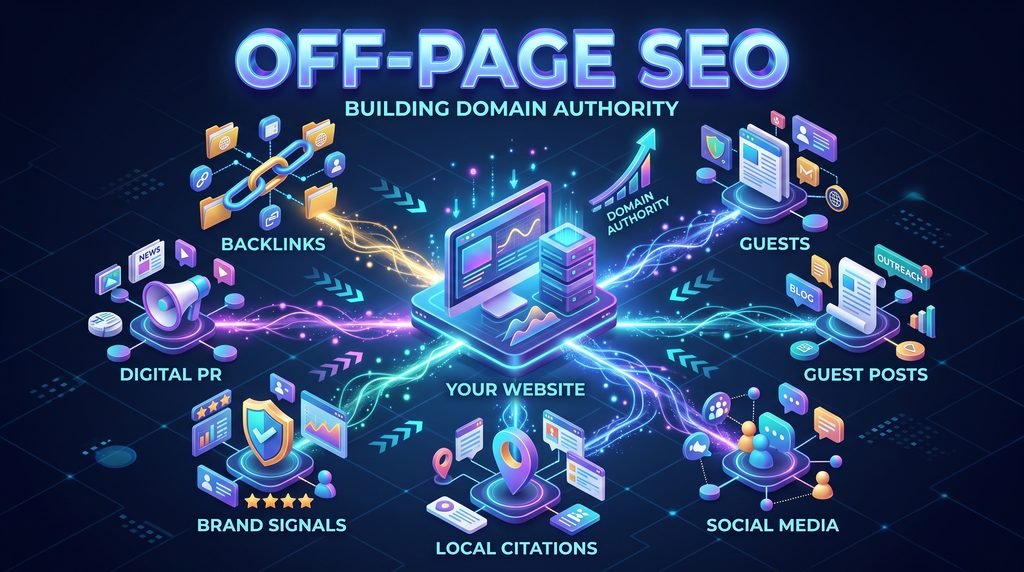
Mastering Off-Page SEO: The Ultimate Guide to Building Domain Authority and Digital Trust
Search engine optimization is fundamentally divided into two distinct but deeply interconnected halves. If on-page SEO is the process of ensuring your website is perfectly structured and relevant to a user’s search intent, off-page SEO is how you prove to search engines that your site is actually worth ranking. Google and other search engines rely heavily on off-page signals to determine one critical factor: trust.
According to industry surveys, off-page SEO factors can account for over 50% of the weight in search engine ranking algorithms. You can have the most technically sound, beautifully designed website with perfectly optimized content, but without a strong external digital footprint, competing in aggressive markets is nearly impossible.
This comprehensive guide breaks down the core off-page SEO factors, effective outreach strategies, and how to build a robust backlink profile that withstands algorithm updates and drives sustainable organic growth.
On-Page vs. Off-Page SEO: Understanding the Difference
Before diving into specific off-page strategies, it is helpful to contrast it with on-page SEO.
| Feature | On-Page SEO | Off-Page SEO |
| Primary Goal | Relevance (What your site is about) | Authority (How trusted your site is) |
| Locus of Control | Full control (Your own website) | Partial control (External websites) |
| Key Activities | Keyword optimization, internal linking, site speed, content creation | Link building, digital PR, brand mentions, influencer outreach |
| Core Metric | Organic rankings, bounce rate, time on page | Domain Rating (DR), referring domains, backlink quality |
Two pages with identical on-page quality can rank completely differently based solely on their off-page profile. Off-page optimization validates your content through external endorsements, which search engines interpret as independent verification of value.
1. The Core Off-Page Ranking Factor: Link Authority
Backlinks remain the single most important off-page ranking factor. A backlink is simply a hyperlink from another website pointing to your domain. Search engines treat these links as independent votes of confidence. However, the algorithm has evolved significantly; it is no longer a numbers game, but a sophisticated evaluation of quality, relevance, and context.
Domain Rating and Site Authority
Domain Authority (DA) or Domain Rating (DR) estimates the aggregate trust of a website based on its backlink profile. When building a backlink strategy—particularly for a newly launched domain—securing links from established, high-DR websites passes immense value. A single editorial link from a highly respected technology publication carries exponentially more weight than fifty links from low-quality, automated directories.
Contextual Relevance
Search engines evaluate the topical relevance of the linking site. If you are operating in the IT infrastructure or cloud hosting sector, a backlink from a blog discussing virtual private servers (VPS) or cloud architecture is far more valuable than a backlink from a food blog. The surrounding text and the overarching theme of the referring domain help search engines categorize and trust your site within your specific niche.
Anchor Text Evaluation
Anchor text is the clickable text in a hyperlink. Proper anchor text analysis and optimization are vital for a healthy backlink profile.
- Exact Match: Using the exact keyword you want to rank for (e.g., “buy cloud hosting”). While powerful, overusing exact match anchors looks manipulative to search engines and can trigger spam filters.
- Branded Anchors: Using your brand name (e.g., “NetRouting” or “Prefixx”). These are the safest and most natural-looking anchors.
- Contextual/Descriptive: Using descriptive phrases (e.g., “managing enterprise server deployments”).
A natural, diverse anchor text profile is critical. When conducting link-building outreach, negotiating the right anchor text placement seamlessly within the content ensures maximum SEO impact without raising algorithmic red flags.
Link Velocity
Link velocity refers to the speed at which your website acquires new backlinks. Search engines prefer steady, organic growth. A sudden, unnatural spike in backlinks (often the result of purchasing bulk links) is a strong signal of manipulation. Consistent, compounding outreach efforts out-perform short, sporadic campaigns.
2. Digital PR and Publisher Outreach
Earning high-quality backlinks requires a proactive, highly structured outreach strategy. Waiting for people to naturally discover and link to your content is rarely enough in competitive B2B or technology markets.
Guest Posting and Content Contribution
Guest blogging remains a highly effective way to secure contextual backlinks and establish authority. This involves identifying authoritative publishers in your industry and pitching them high-quality, original content.
A successful guest posting strategy requires:
- Prospecting: Identifying highly relevant domains with strong DR metrics.
- Pitching: Drafting personalized outreach inquiries to site administrators, asking about their guest posting guidelines, editorial standards, and potential advertising or publication rates.
- Execution: Delivering exceptional content that seamlessly integrates your target backlink and optimal anchor text without appearing overly promotional.
Broken Link Building
This tactic involves finding broken links (404 errors) on external websites, contacting the site owner, and suggesting your active, relevant resource as a replacement. It is a win-win: the site owner fixes a broken user experience on their end, and you secure a high-quality backlink.
Unlinked Brand Mentions
Often, your brand, product, or executives will be mentioned in news articles, reviews, or blog posts without a corresponding hyperlink. Monitoring these mentions allows you to reach out to the author and politely request that the mention be turned into a clickable backlink. This is often one of the highest-converting link-building tactics because the publisher is already familiar with and writing about your brand.
3. Brand Signals and Digital Footprint
Google is increasingly relying on broader “entity” signals to understand who you are and whether you are a legitimate business. Off-page SEO extends far beyond hyperlinks into how your brand exists across the wider internet.
Brand Search Volume
When users search specifically for your brand name (or your brand name plus a keyword, like “CloudStage cloud hosting”), it sends a powerful signal to Google that you are a recognized entity with direct demand. High brand search volume can indirectly lift your rankings for non-branded, generic keywords because it establishes foundational trust.
Social Media and Community Engagement
While a link from a social media platform (like LinkedIn, X, or Facebook) is typically marked as “nofollow” (meaning it does not pass direct link equity), social signals still matter. Social media drives content distribution. When you publish a technical whitepaper, a new tool, or an in-depth workbook, promoting it on social channels gets it in front of other creators, bloggers, and journalists.
Engaging consistently in industry-specific communities—such as specialized subreddits, GitHub discussions, or professional IT forums—builds a trusted presence. Providing thoughtful, in-depth responses rather than mere self-promotion establishes you as an authority and often leads to organic backlinks.
4. Local Off-Page SEO: Citations and Reviews
For businesses that serve specific geographic areas—or enterprise companies with regional data centers and physical offices—local off-page SEO is critical.
NAP Consistency (Name, Address, Phone)
A citation is any online mention of your business’s Name, Address, and Phone number (NAP). These citations appear on business directories, social platforms, and local chambers of commerce. Search engines use NAP consistency as a primary trust signal. If your business information is inconsistent across the web, search engines lose confidence in your data, which can severely damage local search visibility.
The Power of Online Reviews
Reviews on third-party sites (like Google Business Profile, Trustpilot, or industry-specific review platforms) heavily influence both search rankings and user click-through rates.
Search engines evaluate:
- Volume: The total number of reviews.
- Velocity: How frequently new reviews are posted.
- Sentiment: The average rating and the specific keywords used in the review text.
Building a systematic process to request reviews from satisfied clients after successful deployments or project completions ensures a steady stream of positive sentiment that strengthens your overall off-page profile.
5. Content Marketing as an Off-Page Catalyst
Ultimately, the most sustainable way to build an off-page SEO profile is by creating “linkable assets.” Outreach is infinitely easier when you are pitching something of genuine value.
- Original Data and Research: Publishing proprietary data, industry surveys, or performance benchmarks naturally attracts links from journalists and bloggers looking for statistics to cite.
- Comprehensive Resources: Creating downloadable, highly-structured resources—such as printable workbooks, technical checklists, or deployment guides optimized with clean formatting—encourages other sites to link to your page as a definitive resource.
- Free Tools: Offering a free calculator, a speed-test tool, or a DR evaluation widget on your site is one of the most effective ways to generate passive backlinks over time.
Measuring and Managing Off-Page Success
Off-page SEO is not a one-time project; it requires continuous auditing and adjustment. Regularly evaluate your backlink profile against your top competitors.
Key metrics to track include:
- Growth in Referring Domains: Is the total number of unique websites linking to you increasing steadily?
- Quality Distribution: Are you acquiring links from domains with a DR of 50+, or mostly low-tier sites?
- Referral Traffic: Are people actually clicking on the backlinks you secure? High-quality contextual links should drive targeted, relevant visitors to your site.
- Keyword Movement: Correlate your link-building efforts on specific URLs with their movement in search engine results pages (SERPs).
Conclusion
Off-page SEO is the engine of digital authority. While on-page optimization ensures your website is relevant, off-page strategies like aggressive link building, strategic anchor text placement, and consistent publisher outreach are what actually push your pages to the top of competitive search results. By focusing on earning high-quality, topically relevant endorsements, you build a digital footprint that not only satisfies search engine algorithms but also establishes your brand as a trusted leader in your industry.