
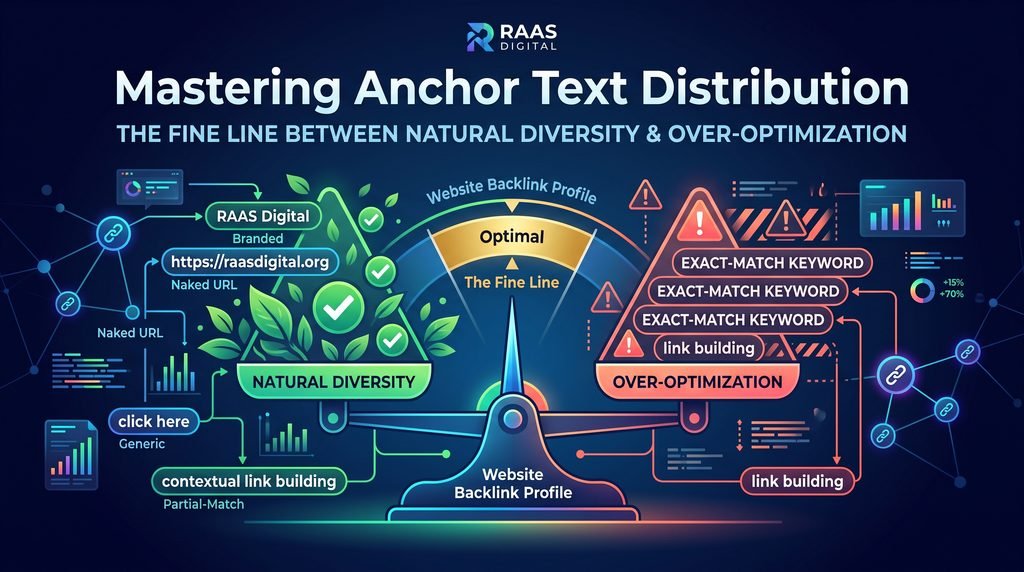
Mastering Anchor Text Distribution: The Fine Line Between Natural Diversity and Over-Optimization
In modern search engine optimization, acquiring high-authority backlinks is only half the battle. While securing contextual link placements from reputable publisher sites remains a cornerstone of off-page SEO, the specific text used to anchor those links carries immense weight.
Ever since Google’s Penguin algorithm updates fundamentally changed how links are evaluated, heavy-handed exact-match keyword manipulation has been a fast track to algorithmic suppression. Today, achieving sustainable top rankings requires a sophisticated, nuanced approach to anchor text distribution that mimics natural editorial linking patterns while strategically signaling topical relevance to search crawlers.
1. The Core Categories of Anchor Text
Before mapping out a link-building strategy, you must understand the primary classifications of anchor text and how search engines interpret each one within its surrounding context.
Branded Anchors
- Definition: Using your brand name, company name, or variations of your domain (e.g., RaasDigital, Raas Digital SEO, raasdigital.org).
- Role: These should form the largest percentage of any healthy backlink profile. They establish brand authority and signal zero manipulation to search algorithms.
Exact-Match and Partial-Match Anchors
- Definition: Exact match uses the precise target keyword you want to rank for (e.g., contextual link building services). Partial match includes your keyword alongside modifier words (e.g., learn more about white hat link building).
- Role: Crucial for signaling relevance, but must be used sparingly. Over-relying on exact-match anchors is the primary trigger for algorithmic penalties.
Naked URLs
- Definition: The raw URL itself functioning as the anchor (e.g., https://raasdigital.org/blog/link-building-guide).
- Role: Highly natural. Users frequently share raw links across forums, social media, and reference lists, making naked URLs essential for a balanced profile.
Generic and Call-to-Action Anchors
- Definition: Non-descriptive phrases such as click here, read this article, website, or source.
- Role: While they convey minimal topical relevance to search engines, they occur naturally in everyday publishing and help maintain overall profile diversity.
2. Reverse-Engineering Competitor Profiles with Ahrefs
Rather than guessing ideal anchor percentages, successful off-page campaigns rely on empirical data. Using tools like Ahrefs Site Explorer allows you to examine the backlink profiles of top-ranking competitors in your specific niche.
- Plug in Top Competitors: Enter the domains of sites currently dominating your target search engine result pages (SERPs).
- Navigate to the Anchors Report: Filter the backlink data by anchor text to see the exact breakdown of branded, exact-match, and broad terms driving their rankings.
- Identify the Baseline: Note the ratio of branded to exact-match anchors. In most competitive industries, branded anchors make up 60% to 80% of the total profile, whereas exact-match anchors rarely exceed 3% to 5%.
3. Strategic Anchor Text Mapping for Outreach Campaigns
When conducting publisher outreach and placing guest contributions or editorial links, mapping your anchors requires aligning them with the intent and depth of the target page.
- Match Anchors to Page Intent: Informational blog posts and comprehensive guides naturally attract more broad, branded, and naked URLs. Commercial landing pages and service hubs can support slightly higher concentrations of partial-match variations, but must still be buffered heavily by brand mentions.
- Prioritize Surrounding Context: Search engines read the sentence and paragraph surrounding the link (co-occurrence). A well-written, topically relevant paragraph around a generic or brand anchor often passes more contextual relevance safely than forcing an awkward exact-match keyword into the text.
- Rotate Variations: Never use the exact same anchor phrase across multiple guest posts pointing to the same target URL within a short window. Diversification protects your site from velocity spikes that signal unnatural link manipulation.
4. Ongoing Monitoring and Maintenance
A backlink profile is dynamic. Competitors, negative SEO attacks, or legacy guest-posting campaigns can skew your anchor distribution over time.
- Audit Regularly: Conduct quarterly reviews of your anchor text profile to ensure exact-match ratios remain within safe thresholds.
- Disavow When Necessary: If toxic or heavily over-optimized spam links point to your domain, neutralize their impact promptly using a properly structured disavow file.
Conclusion
Mastering anchor text distribution is an exercise in restraint and strategy. By prioritizing brand safety, leveraging data-driven competitor benchmarks, and maintaining a diverse, natural mix of anchor types, you protect your digital assets from algorithmic volatility while steadily climbing the search engine rankings.