
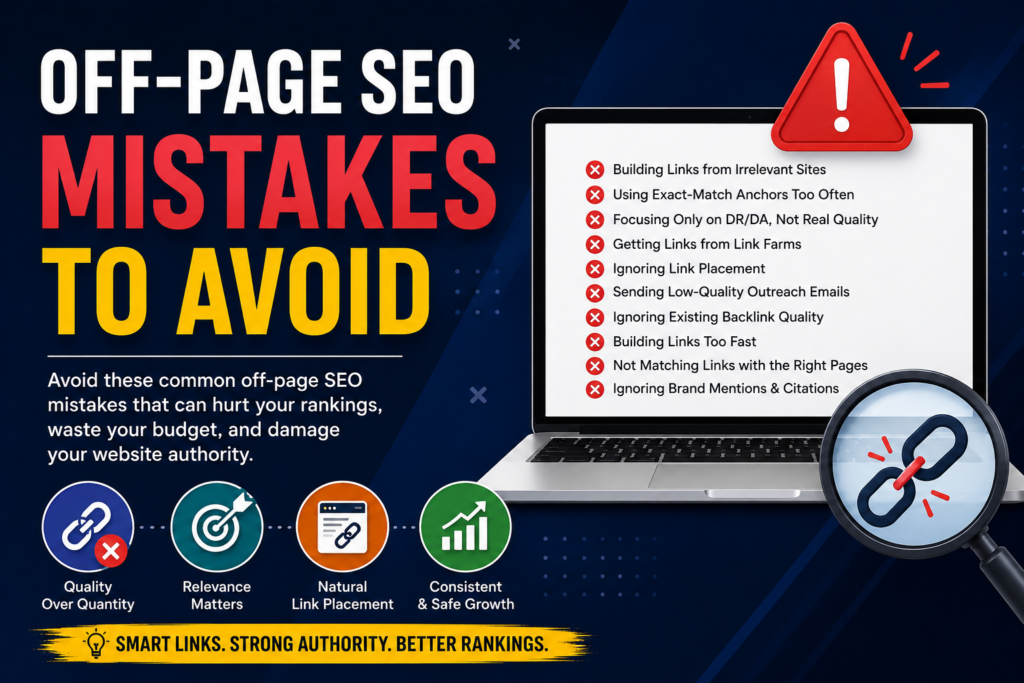
Off-Page SEO Mistakes to Avoid
Introduction
Off-page SEO is one of the most powerful ways to improve website authority, but it can also damage your rankings if done incorrectly. Many website owners focus only on getting more backlinks, without checking quality, relevance, anchor text, or website traffic.
A strong off-page SEO strategy is not about getting links from anywhere. It is about earning or building relevant, trustworthy, and natural backlinks that support your website’s topic.
Here are the most common off-page SEO mistakes to avoid.
1. Building Links From Irrelevant Websites
Relevance is one of the most important factors in link building. A backlink from a website in your niche is usually more valuable than a random link from an unrelated website.
For example, if you run a hosting company, links from technology, cloud, cybersecurity, SaaS, and business websites make sense. Links from gambling, celebrity gossip, or random coupon sites do not look natural.
Always ask: “Would this link make sense for a real reader?”
2. Using Exact-Match Anchors Too Often
Anchor text is the clickable text used in a backlink. Exact-match anchors can be useful, but overusing them can look unnatural.
For example, if every backlink uses the anchor “best SEO agency,” it may look manipulated.
Use a natural mix of:
- Branded anchors
- URL anchors
- Partial-match anchors
- Generic anchors
- Long-tail anchors
- Natural sentence anchors
A healthy anchor profile looks natural and varied.
3. Choosing DR or DA Over Real Quality
Many people buy or build links only because a website has high DR or DA. These metrics are useful, but they are not enough.
Before choosing a website, check:
- Topical relevance
- Organic traffic
- Ranking keywords
- Spam score
- Outbound link quality
- Content quality
- Traffic country
- Link placement context
A high-DR website with no real traffic or irrelevant content may not help your SEO.
4. Getting Links From Link Farms
Some websites exist only to sell backlinks. They publish content on every topic and have too many outbound links.
Signs of a link farm include:
- Articles on unrelated niches
- Too many sponsored posts
- Low organic traffic
- Poor content quality
- Random outbound links
- No clear audience
- Repeated guest post patterns
Avoid these websites because they can make your backlink profile look spammy.
5. Ignoring Link Placement
Where your link appears matters. A link inside a relevant paragraph is usually better than a link placed randomly in the conclusion, author bio, sidebar, or footer.
Good link placement should feel natural. The sentence before and after the link should support the target page.
Avoid forced lines like:
“Visit this website for the best solution.”
Instead, use helpful context that makes sense for the reader.
6. Sending Low-Quality Outreach Emails
Bad outreach emails reduce your approval rate. Editors receive many link requests, so your message should be short, clear, and relevant.
Avoid:
- Long emails
- Generic templates
- Wrong website names
- Overly promotional language
- Irrelevant target pages
- Demanding anchor text
A good outreach email explains the value of the edit and why it fits the article.
7. Ignoring Existing Backlink Quality
Many businesses focus on new backlinks but never audit existing backlinks. Your website may already have spammy or low-quality links.
Check your backlink profile regularly and look for:
- Spam domains
- Irrelevant links
- Toxic anchor patterns
- Sudden link spikes
- Links from hacked pages
- Links from copied content
Not every bad-looking link needs action, but you should understand your backlink profile.
8. Building Links Too Fast
A sudden spike in backlinks can look unnatural, especially for a new website. Link building should look steady and realistic.
Instead of building too many links at once, create a monthly plan based on your website age, current authority, and competition.
Quality and consistency are better than speed.
9. Not Matching Links With the Right Pages
Many websites build all backlinks to the homepage. This can be a mistake. Your service pages, blog posts, tools, and landing pages may also need backlinks.
Create a proper link distribution plan.
Example:
- Homepage for branded authority
- Service pages for commercial keywords
- Blog posts for informational keywords
- Tools/templates for natural links
- Location pages for local SEO
This helps your overall SEO structure.
10. Forgetting About Brand Mentions
Not every off-page SEO win comes from direct link building. Brand mentions, reviews, citations, interviews, and social visibility also help build trust.
Focus on building your brand across:
- Google Business Profile
- Industry directories
- Review websites
- Social platforms
- Podcasts
- Expert roundups
- Local media
The stronger your brand presence, the easier link building becomes.
Conclusion
Off-page SEO can improve rankings, traffic, and authority, but only when done carefully. Avoid irrelevant backlinks, exact-match anchor overuse, link farms, poor outreach, and low-quality placements.
The best off-page SEO strategy focuses on relevance, quality, natural anchors, useful content, and long-term consistency.