
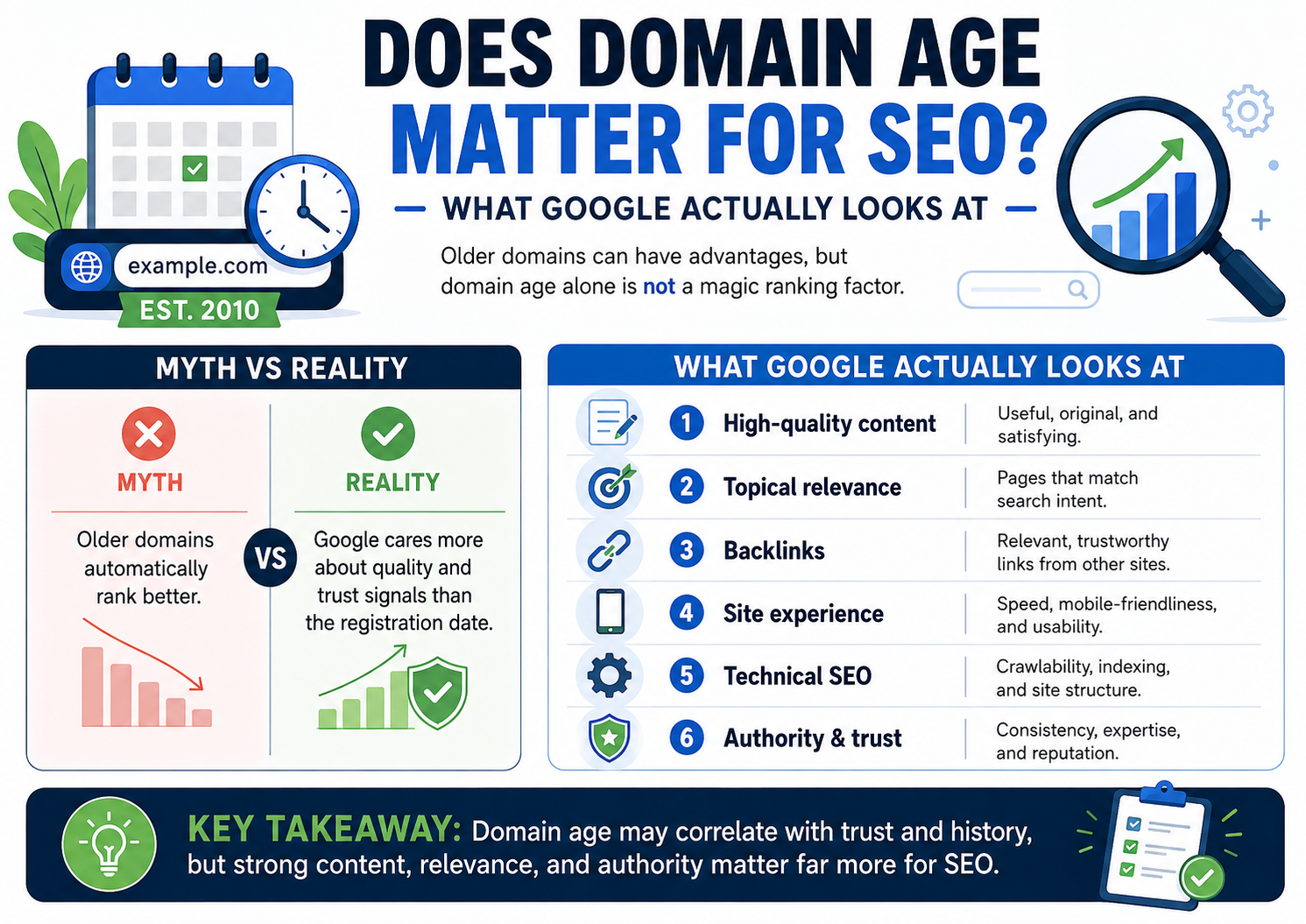
Does Domain Age Matter for SEO? What Google Actually Looks At
An eight-year-old domain ranks above you.
Your website was launched six months ago.
It is easy to reach an obvious conclusion:
Google trusts older domains more.
That belief has influenced SEO decisions for years. Businesses pay premiums for aged domains, marketers hesitate to launch projects on new domains, and expired-domain sellers frequently emphasize registration age as if it were an SEO score.
But does domain age actually matter for SEO?
The short answer is:
Domain age itself is not a direct Google ranking factor.
Google’s John Mueller has repeatedly rejected the idea that simply owning an older domain provides a ranking advantage. Google Search documentation also describes ranking as the result of many page-level and site-level signals rather than a simple domain-age calculation.
So why do older websites frequently appear to perform better?
Because an established website may have spent years accumulating things that actually matter:
- relevant backlinks;
- useful content;
- brand recognition;
- internal links;
- topical coverage;
- mentions across the web;
- returning users;
- established pages.
That distinction matters enormously if you’re deciding whether to buy an aged domain for SEO, evaluating an expired domain, or comparing an old competitor with a new website.
Age tells you how long a domain has existed.
It does not tell you what happened during those years.
Before evaluating an aged domain, you can use the RAAS Digital Domain Age Checker to see its estimated age, creation date, registrar, expiry information, nameservers, DNS records, status, IP, MX, and other available technical details.
But don’t stop at the age.
Here’s what actually matters.
Does Domain Age Affect Google Rankings?
Not directly.
Google’s John Mueller has been particularly clear on this subject. When asked whether domain age affects search rankings, he has said that domain age itself does not provide a ranking advantage. (Search Engine Journal)
Google’s current documentation takes a broader view of ranking.
Its automated ranking systems evaluate many factors and signals across hundreds of billions of pages and other content. Google also notes that many ranking systems operate primarily at the page level while some site-wide signals and classifiers contribute additional context. (Google Search Central)
Notice what that means.
Google doesn’t describe rankings as:
Older domain = more ranking points.
Instead, ranking depends on whether a page appears relevant and useful for a particular search.
So if you register:
examplebusiness.com
today, Google does not automatically place you behind another company simply because its domain was registered in 2012.
Your challenge is building the signals and content necessary to compete.
Then Why Do Older Domains Often Rank Better?
This is where correlation gets confused with causation.
Imagine two companies.
Website A
Domain age: 11 years
During those 11 years, it has:
- published 400 useful articles;
- earned links from industry publications;
- created comprehensive service pages;
- been mentioned by customers and partners;
- developed strong internal linking;
- built brand recognition.
Website B
Domain age: 4 months
It has:
- 15 pages;
- few referring domains;
- limited content;
- little brand awareness.
Website A may rank significantly better.
But did it win because Google looked at the registration date and awarded an “11-year bonus”?
No.
It had 11 years to build SEO assets.
That difference is crucial.
Domain Age Is a Timeline, Not an SEO Score
One of the easiest ways to understand domain age is to think of it as a timeline.
Suppose a domain is 15 years old.
That tells you the domain has potentially had 15 years to:
- earn backlinks;
- publish content;
- develop a reputation;
- attract traffic;
- build brand mentions.
It has also had 15 years to:
- accumulate spam links;
- change industries;
- be abandoned;
- host questionable content;
- participate in link schemes.
Age alone tells you none of those things.
It tells you that a history potentially exists.
That is why the first step when researching an aged domain should be to check its age and registration details, then investigate what occurred during that period.
RAAS Digital’s free Domain Age Checker is designed for that initial screening step.
Check Domain Age Before Making an SEO Decision
If you’re evaluating an existing domain, start with factual information.
The RAAS Digital Domain Age & Info Checker can show available:
- domain creation date;
- estimated age;
- expiration date;
- registrar;
- domain status;
- nameservers;
- DNS information;
- IP information;
- MX records;
- HTTPS-related information.
Check a domain here:
https://raasdigital.org/tools/domain-age-checker/
RAAS Digital retrieves public RDAP/domain data and performs basic DNS checks. Availability can vary between registries and TLDs.
The result should answer:
How old is this domain?
The next stage answers the more important question:
Is its history actually valuable?
What Google Actually Looks At Instead of Domain Age
There isn’t one replacement metric called “trust.”
SEO does not work that neatly.
Google’s Search Essentials recommends focusing on helpful, reliable, people-first content, using descriptive words people actually search for, making links crawlable, and following Google’s spam policies. (Google Search Central)
Several areas deserve far more attention than the number of years a domain has been registered.
1. Relevant, Helpful Content
An old domain with poor content does not become useful because it has survived for 15 years.
A page still needs to answer the searcher’s question.
If someone searches:
best managed hosting provider for small business
Google needs to determine which results best satisfy that intent.
The registration birthday of each domain does not replace:
- useful comparisons;
- accurate information;
- clear explanations;
- original insight;
- appropriate page structure.
A new website can compete by creating a better answer.
2. Backlinks
This is probably one of the biggest reasons older websites appear stronger.
Backlinks take time to accumulate.
A website operating since 2010 may have been referenced by:
- journalists;
- industry associations;
- customers;
- universities;
- bloggers;
- business partners;
- software directories;
- trade publications.
A website registered three months ago has had far less opportunity.
That doesn’t mean Google rewards the age.
It means the established website may already possess an asset that took years to build.
This is an important distinction when comparing old domains vs new domains for SEO.
3. Topical Depth
Established websites frequently have more comprehensive coverage.
Imagine a hosting company that has published for ten years.
It may have resources covering:
- cloud hosting;
- dedicated servers;
- virtualization;
- DDoS protection;
- networking;
- data centers;
- server security;
- colocation.
That depth can provide far stronger topical context than a new hosting website with three articles.
Again, the advantage comes from what was built during those years—not the calendar itself.
4. Internal Linking
Older websites often contain hundreds or thousands of pages.
When maintained properly, that creates significant internal-linking opportunities.
A new article can immediately receive contextual links from:
- established guides;
- category pages;
- service pages;
- related articles.
A new website has fewer pages available to support new content.
That advantage grows over time.
But it is a website-architecture advantage, not a registration-age ranking factor.
5. Links and Mentions From Other Websites
Google explicitly recommends creating compelling content that people naturally want to link to and warns against artificial link schemes. (Google Search Central)
An established company has simply had more opportunities to be:
- reviewed;
- quoted;
- referenced;
- discussed;
- recommended.
Those signals can create an advantage that looks like “domain age.”
It isn’t the same thing.
6. Page Experience
An old website isn’t automatically technically superior.
Google’s current page-experience guidance encourages website owners to consider factors such as Core Web Vitals, mobile usability, secure delivery, intrusive interstitials, and whether users can easily access the main content. (Google Search Central)
A 15-year-old website with:
- terrible mobile UX;
- slow pages;
- intrusive advertisements;
- outdated navigation
can still provide a poor experience.
A two-year-old competitor may be much better.
Domain Age vs Domain Authority: Which Matters More?
These metrics answer different questions.
Domain age asks:
How long has this domain been registered?
Domain authority metrics ask:
How strong does a third-party SEO platform estimate this domain’s link profile to be?
Neither metric directly represents Google’s rankings.
But both can be useful for research.
Consider:
| Website | Domain Age | DR | Traffic | Backlink Quality |
| Site A | 16 years | 18 | Low | Weak |
| Site B | 7 years | 61 | Strong | Strong |
| Site C | 1 year | 52 | Moderate | Needs investigation |
Site A is the oldest.
That doesn’t automatically make it the strongest.
Site C may be perfectly legitimate.
But a one-year-old domain reaching strong third-party authority metrics quickly deserves additional investigation.
That is how SEOs should use domain age:
as context.
Should You Buy an Aged Domain for SEO?
This is where the question becomes commercially important.
Aged domains can sell for hundreds, thousands, or even tens of thousands of dollars.
If you’re considering paying a premium because a seller says:
“This domain is 18 years old.”
ask:
What exactly am I buying besides age?
A genuinely valuable aged domain may come with:
- strong relevant backlinks;
- established branded mentions;
- clean historical content;
- memorable branding;
- previous industry authority;
- referral traffic.
An aged domain without those assets may simply be:
an old domain.
Is an Aged Domain Worth Paying More For?
Sometimes.
Consider two acquisition opportunities.
Domain A
Age: 14 years
Price: $5,000
History:
- parked for most of its existence;
- no meaningful traffic;
- weak backlinks;
- little brand value.
Domain B
Age: 6 years
Price: $5,000
History:
- legitimate business;
- relevant industry content;
- strong editorial backlinks;
- existing branded searches;
- good topical match.
If your objective is SEO, Domain B may be far more valuable.
The seller of Domain A may heavily advertise its age because there isn’t much else to advertise.
Don’t pay for years.
Pay for valuable assets.
Domain Age Checklist Before Buying an Aged Domain
If you’re considering purchasing an aged domain for SEO, use this sequence.
Step 1: Check the Registration Age
Start with the RAAS Digital Domain Age Checker.
Confirm:
- registration date;
- age;
- registrar;
- expiry;
- nameservers;
- status.
If the seller advertises a 12-year-old domain, verify that available public registration information is consistent with the claim.
Step 2: Investigate Domain History
Now ask:
What did this domain actually host?
A domain might have changed from:
Technology → Gambling → Crypto → AI
That history deserves much more scrutiny than:
Cybersecurity → IT Services → Cloud Security
Topical continuity is particularly important when you’re buying a domain because you intend to rebuild it.
Step 3: Check Backlinks
Review both quality and relevance.
Don’t stop at:
2,000 referring domains.
Ask:
- Who are those domains?
- Are they real websites?
- Are they relevant?
- Which pages received links?
- Why were the links created?
- What anchors were used?
A domain can have impressive aggregate metrics while the underlying links are poor.
Step 4: Check Existing Organic Visibility
Does the domain still rank?
Does it have:
- relevant keywords;
- organic pages;
- branded searches;
- traffic?
A domain with ongoing organic visibility is a different acquisition from one that disappeared from search years ago.
RAAS Digital’s Website Traffic & SEO Estimate Checker can help with an initial screening before deeper analysis.
Step 5: Check Spam Risk
Older does not mean cleaner.
A domain may have changed ownership several times.
Previous owners could have used it for:
- paid links;
- spam;
- doorway pages;
- unrelated affiliate content;
- hacked pages.
Use RAAS Digital’s Spam Score Checker as an initial risk screen and then perform manual backlink and history checks before making a significant purchase.
Step 6: Check Topical Relevance
If you’re buying an aged domain for a finance project, a historically relevant finance or business domain may be more attractive than a 20-year-old pet blog.
RAAS Digital’s Website Industry Finder can help classify a site’s current niche and audience during initial research.
Step 7: Decide Whether the Price Makes Sense
Only now should the conversation reach price.
Not:
“It’s 15 years old, so $4,000 sounds reasonable.”
Instead:
“It’s 15 years old, has relevant history, strong editorial links, clean anchors, an appropriate niche, and remaining traffic. Is $4,000 reasonable for those assets?”
That’s a much better buying decision.
Does Domain Age Matter When Buying an Expired Domain?
Yes—as a research signal.
No—as a reason to buy it by itself.
Expired-domain buyers often filter by:
- age;
- backlinks;
- DR;
- referring domains.
But the oldest domain in the list is not necessarily the best.
Suppose you find:
Expired Domain A
Age: 19 years
DR: 44
But:
- unrelated history;
- suspicious anchors;
- no remaining organic visibility.
Expired Domain B
Age: 8 years
DR: 36
But:
- highly relevant previous niche;
- legitimate links;
- clean historical content.
Domain B may be the safer and more commercially useful option.
That’s why the Domain Age Checker should be the beginning of expired-domain research, not the end.
Does Domain Age Matter for Backlinks?
This question matters to agencies and link buyers too.
Imagine a publisher offers you a backlink for $250.
Their metrics show:
DR 70
Traffic 30K
Dofollow link
Before paying, you check the domain.
Registration age:
9 months.
That doesn’t prove the site is bad.
But you should investigate further.
How did it reach DR 70 so quickly?
Where did its backlinks come from?
What keywords generate its traffic?
Does the site have genuine editorial history?
Does it publish across unrelated niches?
Is its traffic concentrated on one irrelevant page?
This is a perfect example of why domain age is useful even though it isn’t a direct Google ranking factor.
It can expose patterns that deserve closer inspection.
A Better Backlink Evaluation Workflow
For link buyers, I recommend:
Domain Age → Niche → Organic Visibility → Backlinks → Spam Risk → Page Relevance → Price
RAAS Digital provides free tools for several stages of that workflow.
Domain Age Checker
Check domain registration and technical information.
Website Industry Finder
Determine whether the website is relevant to your target niche.
Traffic & SEO Estimate Checker
Review initial traffic-potential and SEO signals.
Spam Score Checker
Identify potential risk patterns.
Backlink Relevancy Score Checker
Evaluate whether the source page and your target page actually belong together.
GP/LI Price Calculator
Estimate guest-post or link-insertion pricing after the website has passed your quality checks.
The order matters.
Don’t negotiate a $200 backlink down to $170 before determining whether the website deserves $1.
Old Domain vs New Domain for SEO
Should you start a new project on an old domain or register a new one?
There is no universal winner.
Choose a New Domain When:
- you want a clean brand;
- no relevant aged domain exists;
- historical risks aren’t worth taking;
- the ideal brand name is available;
- you’re building for the long term.
Consider an Existing/Aged Domain When:
- the domain has highly relevant history;
- existing links are valuable;
- the brand makes sense;
- historical content aligns with your project;
- you’ve completed proper due diligence.
The worst strategy is buying a poor aged domain because someone convinced you that “Google trusts old domains.”
Can a New Domain Rank in Google?
Yes.
A new domain is not sentenced to years of poor rankings simply because it is new.
Your priorities should be:
- building useful pages;
- satisfying search intent;
- establishing topical coverage;
- earning legitimate mentions and links;
- creating strong internal links;
- ensuring Google can crawl and index the site;
- providing a good user experience.
Google’s Search Essentials specifically emphasizes useful people-first content and using descriptive language that matches how people search. (Google Search Central)
Those are actionable SEO priorities.
Waiting for your domain’s birthday isn’t.
How Long Does a New Domain Take to Rank?
There is no fixed waiting period.
A newly registered domain might begin ranking for low-competition searches relatively quickly while requiring considerably longer to compete for difficult commercial queries.
Performance depends on factors including:
- competition;
- content;
- website quality;
- backlinks;
- crawlability;
- topic;
- brand strength;
- search intent.
If a new U.S. SaaS company wants to rank for:
CRM software
it faces a very different challenge from a local company targeting:
commercial refrigerator repair Boise
The age of the domain doesn’t explain that competitive difference.
Should You Renew a Domain for Several Years for SEO?
Registering a domain for additional years should not be treated as a Google ranking tactic.
Renew domains for multiple years because:
- you intend to keep the brand;
- you want to reduce renewal risk;
- it simplifies domain management.
Don’t expect:
10-year registration = ranking boost.
SEO investment belongs elsewhere.
Does an Exact-Match Domain Help SEO?
This is related but separate from domain age.
A domain containing the keyword you’re targeting does not automatically dominate Google.
Google’s current ranking-systems guide specifically describes an exact match domain system designed to prevent domains created to exactly match a query from receiving too much credit merely because of the words in their domain name. (Google Search Central)
A descriptive domain can still help users understand a brand.
But:
best-cheap-seo-services-usa.com
does not automatically outrank a strong brand because the domain contains keywords.
Common Domain Age SEO Myths
Let’s clear up several persistent misconceptions.
Myth 1: Every Old Domain Has More Authority
False.
An old domain can have virtually no authority.
Myth 2: Google Automatically Trusts Domains After Several Years
There is no public Google rule saying a website reaches a particular “trust age.”
Myth 3: A 15-Year-Old Domain Will Rank Faster Than a New Domain
Not necessarily.
The history attached to the old domain matters far more.
Myth 4: Domain Age Doesn’t Matter at All
This also oversimplifies the issue.
Age is still useful for:
- due diligence;
- backlink prospecting;
- expired-domain research;
- acquisition analysis;
- detecting unusual metrics.
It simply should not be treated as a direct ranking score.
Myth 5: High DR + Old Domain = Safe Purchase
Definitely not.
You still need to inspect:
- backlinks;
- traffic;
- history;
- niche;
- anchors;
- spam patterns.
How U.S. Businesses Should Think About Domain Age
If you’re launching a business in the United States, don’t delay the project because you cannot find a 10-year-old domain.
A strong new brand with:
- useful content;
- good technical SEO;
- legitimate PR;
- relevant backlinks;
- strong products;
- good user experience
can build search visibility over time.
Buying an aged domain becomes interesting when the domain itself provides an asset worth acquiring.
For example:
Strong reason:
“This domain previously operated in our industry and has legitimate editorial backlinks from relevant U.S. publications.”
Weak reason:
“This domain is 17 years old.”
Those are not equivalent investment theses.
Domain Age for SEO Agencies and Consultants
Domain-age research also helps when evaluating clients.
Suppose a prospective client says:
“We’ve been doing SEO for ten years but still don’t rank.”
Check the domain.
Perhaps it really is ten years old.
Now investigate:
- Does it have content?
- Are important pages indexed?
- Does it have relevant backlinks?
- Has the niche changed?
- Are there technical issues?
- Does the site satisfy commercial search intent?
Domain age provides context.
It doesn’t diagnose the problem.
How to Check Domain Age for SEO Research
Use this simple process.
1. Open RAAS Digital’s Domain Age Checker
Go to:
2. Enter the Website
You can enter a domain or website URL.
3. Run the Check
The tool retrieves available registration and DNS information.
4. Review the Age and Creation Date
Establish the basic timeline.
5. Review Supporting Information
Look at available:
- registrar;
- expiry;
- status;
- nameservers;
- DNS;
- IP;
- MX information.
6. Continue With SEO Due Diligence
Use age as one data point, then analyze the domain’s actual SEO assets.
RAAS Digital specifically describes the tool as useful for screening domains, expired-domain checks, prospect-quality reviews, and quick technical/domain research.
When Domain Age Should Affect Your Buying Decision
Domain age should influence your decision when it causes you to ask better questions.
For example:
Scenario 1
A seller advertises a website as operating since 2014.
Domain creation date appears to be 2025.
Investigate.
Scenario 2
A DR 65 guest-post site is six months old.
Investigate how the authority was built.
Scenario 3
An expired domain is 20 years old but changed niches repeatedly.
Investigate historical use and links.
Scenario 4
A five-year-old domain has strong relevant editorial links and a clean history.
Potentially valuable.
This is the correct commercial use of domain-age information.
What Should You Pay for an Aged Domain?
There is no universal domain-age pricing formula.
You should not value a domain as:
$100 × every year registered.
Commercial value can come from:
- brandability;
- desirable keywords;
- backlink profile;
- existing traffic;
- search demand;
- historical relevance;
- industry value;
- memorable naming;
- business potential.
Age alone may add context, but the underlying assets determine whether the asking price makes sense.
If you’re paying a premium exclusively because the seller highlights the registration date, you’re probably not evaluating enough information.
A Practical Aged Domain SEO Scorecard
Before purchasing an existing domain, score the actual asset.
| Factor | Weight |
| Historical topical relevance | 20 |
| Backlink quality | 20 |
| Organic visibility | 15 |
| Clean domain history | 15 |
| Brand/commercial fit | 10 |
| Spam risk | 10 |
| Domain age | 5 |
| Technical/registration signals | 5 |
| Total | 100 |
Notice that domain age receives only five points.
That is intentional.
It matters as context.
It should not overpower stronger evidence.
Domain Age Is Useful — Just Not for the Reason Many People Think
There are two bad extremes.
The first is:
“Domain age is one of Google’s biggest ranking factors.”
That is unsupported.
The second is:
“Domain age is completely useless.”
That isn’t practical either.
Domain age can be extremely useful for:
- SEO due diligence;
- backlink screening;
- website acquisitions;
- aged-domain research;
- expired-domain research;
- competitor analysis;
- identifying unusual site metrics.
The key is understanding what it tells you.
Age tells you how long a history could exist.
Then you investigate the history.
Use RAAS Digital’s Domain Age Checker Before You Buy
If you’re researching an aged domain, backlink prospect, expired domain, or existing website, checking the registration age takes seconds.
RAAS Digital’s Domain Age & Info Checker provides available:
- domain age;
- creation date;
- expiration information;
- registrar;
- nameservers;
- DNS;
- domain status;
- IP;
- MX information.
Check domain age free:
https://raasdigital.org/tools/domain-age-checker/
Then combine the result with RAAS Digital’s other SEO tools for:
- traffic estimation;
- spam-risk screening;
- industry classification;
- backlink relevance;
- domain authority screening;
- guest-post/link-insertion evaluation.
That gives you a much stronger picture than domain age alone.
Final Verdict: Does Domain Age Matter for SEO?
Not as a direct Google ranking factor.
An old domain does not receive a ranking bonus simply because it was registered many years ago. Google has repeatedly pushed back on that idea, and its current ranking documentation describes much broader page-level and site-level systems. (Google Search Central)
What matters is what the domain accumulated during those years.
A legitimate established site may have:
- valuable backlinks;
- strong content;
- topical depth;
- brand recognition;
- useful pages;
- industry mentions.
Those assets can create a substantial competitive advantage.
But an old domain that spent 15 years parked or passing through spam projects may provide little SEO value at all.
So don’t ask only:
“How old is this domain?”
Ask:
“What did this domain build during that time?”
Use the RAAS Digital Domain Age Checker to establish the age.
Then investigate the assets behind it.
That’s how domain age becomes useful for SEO.
Frequently Asked Questions
Does domain age matter for SEO?
Domain age itself is not considered a direct Google ranking factor. Older websites can perform well because they have had more time to accumulate content, backlinks, brand mentions, and other useful assets.
Is domain age a Google ranking factor?
Google representatives, including John Mueller, have repeatedly said domain age itself does not provide a ranking advantage. Google’s published ranking documentation instead describes many page-level and site-level signals. (Search Engine Journal)
Does an old domain rank faster?
Not automatically. An established domain with clean, relevant backlinks and useful historical content may have advantages, but an old registration date alone does not guarantee faster rankings.
Can a new domain rank on Google?
Yes. New domains can rank when they provide useful content, satisfy search intent, earn legitimate links, and meet Google’s technical requirements.
Should I buy an aged domain for SEO?
Consider buying one only after investigating its backlink profile, historical content, organic visibility, niche relevance, spam risk, branding, and commercial value. Age alone is not enough reason to purchase.
How do I check domain age?
Use a domain age lookup tool such as RAAS Digital’s free Domain Age & Info Checker. It uses available public RDAP/domain information and DNS checks to report registration and technical information.
Is a 10-year-old domain better than a 2-year-old domain?
Not necessarily. The two-year-old domain could have stronger content, better links, more relevant traffic, and a cleaner history.
Does domain registration length affect SEO?
Registering a domain for many years in advance should not be viewed as an SEO ranking tactic. Register for longer periods because it makes sense for domain management, not because you expect a ranking boost.
Why do older websites often rank higher?
Established websites have had more time to publish content, earn backlinks, develop internal links, receive brand mentions, and build topical coverage. These accumulated assets can explain much of the apparent correlation between age and rankings.
Should I check domain age before buying a backlink?
Yes. Domain age can provide useful context, particularly when a website has unusually high authority or traffic metrics for a very new domain. It should be combined with backlink, traffic, niche, spam-risk, and page-relevance analysis.
What is the best domain age checker for SEO?
For SEO research, choose a checker that provides more than an age number. RAAS Digital’s Domain Age Checker includes available creation date, registrar, expiry, nameservers, DNS, status, IP, MX, and other technical information useful for initial domain screening.