
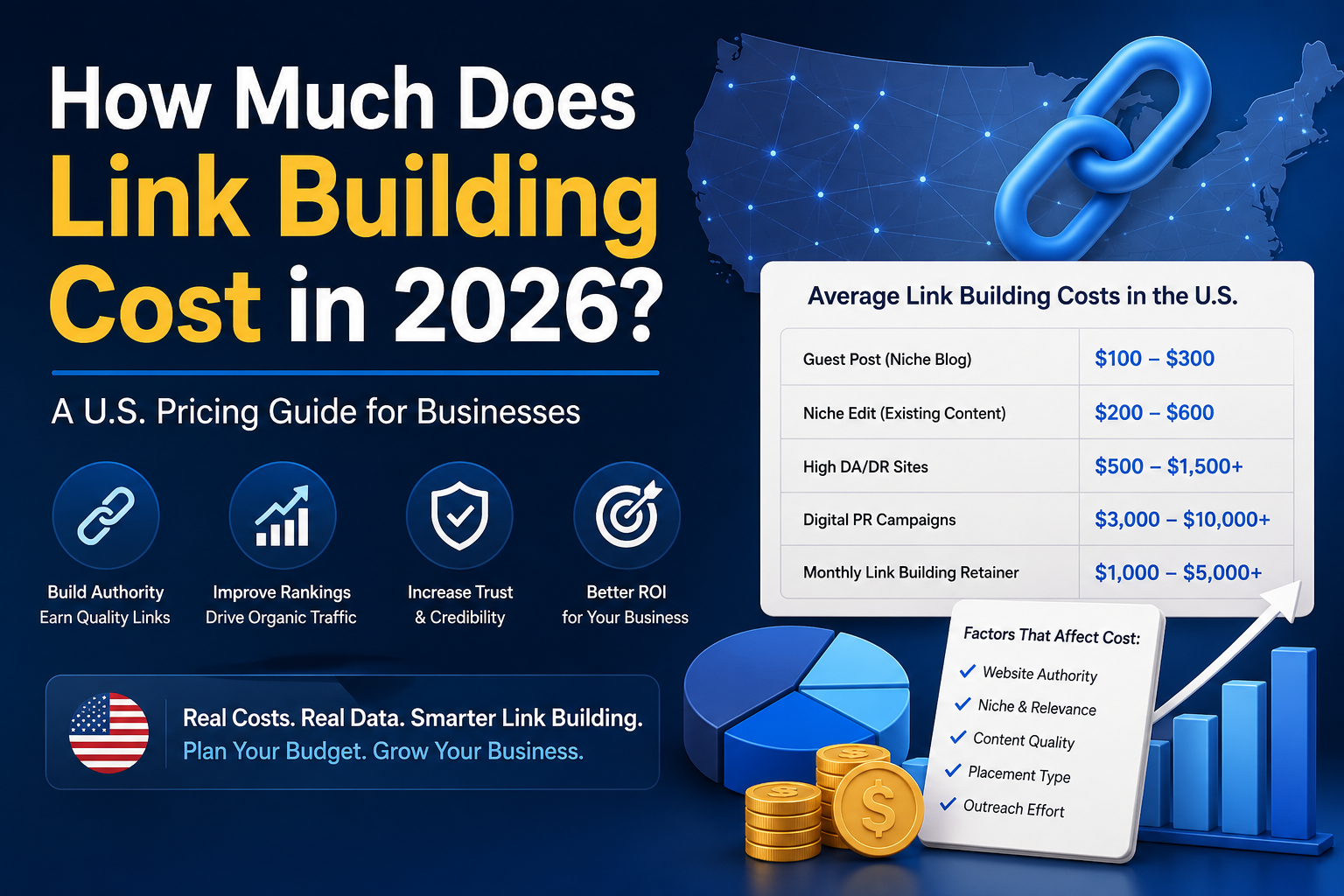
How Much Does Link Building Cost in 2026? A U.S. Pricing Guide for Businesses
If you are considering link building for your business, one of the first questions is usually simple:
How much should I actually pay for backlinks?
Unfortunately, the answer is rarely simple.
One provider may offer links for $50 each. Another may quote $300. A specialist SEO agency might ask for $3,000 to $10,000 per month. Digital PR campaigns can cost considerably more.
Those prices do not necessarily represent the same service.
A $100 placement on a highly relevant website with genuine U.S. search traffic can sometimes be a better investment than a $400 placement chosen primarily because the domain has an impressive authority metric.
For businesses evaluating SEO services, understanding link building pricing is therefore less about finding the cheapest backlink and more about understanding what you are actually buying.
This guide breaks down link building costs in 2026, explains the major pricing models, and gives U.S. businesses a practical framework for deciding whether a placement is worth the money.
Link Building Cost at a Glance
There is no universal price for a backlink.
Current market pricing varies significantly depending on the method, publisher, domain quality, outreach effort, content requirements and level of service.
As a general reference point:
| Link Building Option | Typical Market Position | Best For |
| DIY outreach | Lowest direct cost, highest time investment | SEO teams with internal resources |
| Link insertions / niche edits | Low to mid-range per placement | Businesses wanting contextual links from existing pages |
| Guest posts | Mid-range | Brands needing both content and a contextual link |
| Managed link building | Higher monthly investment | Businesses wanting outreach handled for them |
| Digital PR | Premium | Established brands seeking editorial coverage and authority |
One large 2026 BuzzStream analysis covering more than 400,000 websites found that link insertions averaged approximately $179, although prices varied substantially according to website authority and other characteristics.
That number is useful as a market benchmark, but it should never be treated as the “correct” price for every link.
A backlink worth $179 on one site might be worth almost nothing on another.
Why Backlink Pricing Varies So Much
Businesses often compare backlinks as if they were identical products.
They are not.
Several factors can influence backlink cost.
1. Website Quality
Websites with established audiences, genuine organic traffic, strong editorial standards and reputable brands generally charge more.
However, third-party metrics such as DR or DA should not be used by themselves.
A high-authority domain can still have:
- declining organic traffic;
- unrelated content;
- excessive sponsored posts;
- weak individual pages;
- poor U.S. visibility;
- hundreds of commercial outbound links.
That is why serious backlink evaluation needs to look beyond one metric.
2. Topical Relevance
Relevance can significantly affect the practical value of a placement.
Imagine a cybersecurity company choosing between:
Website A
- DR 75
- general lifestyle website
- no cybersecurity audience
and
Website B
- DR 55
- cloud infrastructure publication
- articles about hosting, network security and enterprise IT
Website A looks stronger if you only compare DR.
Website B may be considerably more useful because the relationship between the source content and target website makes sense to readers.
Before paying for any placement, ask:
Would someone reading this article reasonably benefit from clicking my link?
If the answer is no, the placement deserves much more scrutiny.
3. Organic Traffic
Real search visibility is another useful quality signal.
A website attracting consistent search traffic is generally more attractive than a domain that maintains impressive authority metrics but has almost no ranking footprint.
Pay attention to:
- estimated monthly organic traffic;
- ranking keyword trends;
- traffic growth or decline;
- top-ranking pages;
- traffic source countries;
- whether the site ranks within its actual niche.
For U.S.-focused businesses, country relevance deserves particular attention.
If you are trying to acquire customers in the United States, a publisher whose audience and search visibility are predominantly U.S.-based may be more commercially useful than one whose traffic comes almost entirely from unrelated markets.
4. Page-Level Quality
Do not evaluate only the domain.
Evaluate the page where your backlink will appear.
An existing article with search traffic, backlinks, useful content and strong contextual relevance can make a link insertion attractive.
A forgotten article buried hundreds of pages deep may offer much less value even if the domain itself looks excellent.
Look at:
- page topic;
- page traffic;
- existing ranking keywords;
- internal links;
- content quality;
- publication date and updates;
- number of outbound links;
- how naturally your link can be added.
5. Editorial Standards
A website that carefully reviews submissions will normally have fewer irrelevant outbound links.
That is often a good sign.
By contrast, websites publishing articles about cryptocurrency, plumbing, casinos, SaaS, pets, fashion and accounting within the same week may warrant additional investigation.
The easier it is for anyone to purchase any anchor on any page, the more carefully you should evaluate the site.
How Much Do Link Insertions Cost?
A link insertion, sometimes called a niche edit, involves placing a link inside an article that has already been published.
These placements are popular because the content already exists and may already have:
- age;
- backlinks;
- ranking keywords;
- search traffic;
- internal links.
According to BuzzStream’s 2026 dataset, the average link-insertion price was approximately $179, while higher-authority websites could command substantially more.
Public link-building providers also show considerable variation, with entry-level placements starting around the lower double digits while higher-quality or managed options can reach several hundred dollars per link.
When Is a Link Insertion Worth Paying For?
Consider paying a premium when:
- the existing article is closely related to your target page;
- the publisher has real organic visibility;
- the article is indexed;
- the placement fits naturally;
- the site has a genuine audience;
- U.S. traffic is relevant to your campaign;
- the page is not overloaded with commercial links.
Be cautious when the seller’s entire pitch is:
DR 80 — dofollow — permanent.
Those three words tell you very little about whether the backlink is actually useful.
How Much Do Guest Posts Cost?
Guest post pricing usually includes more work than a basic link insertion.
Depending on the provider, you may be paying for:
- topic research;
- content writing;
- editing;
- publisher communication;
- publication;
- placement fees;
- campaign management.
Public 2026 pricing across link-building providers shows guest post placements ranging from relatively inexpensive productized options to several hundred dollars per placement.
The important question is not simply:
How much does a guest post cost?
Ask instead:
What is included in that price?
A $100 guest post where you must provide the article, find the topic and accept an irrelevant publisher is very different from a $300 service involving prospecting, editorial coordination and content production.
Link Insertions vs Guest Posts: Which Gives Better Value?
Neither option is automatically better.
Choose according to the opportunity.
Link Insertions May Be Better When:
- a highly relevant existing article already exists;
- the page has established search visibility;
- your target page fits naturally into the discussion;
- you want faster placement;
- you do not need a completely new article.
Guest Posts May Be Better When:
- no relevant existing page exists;
- you want more control over the surrounding topic;
- you want brand exposure in addition to the backlink;
- the publisher has a strong audience;
- the content itself can generate referral traffic.
For many campaigns, the most sensible strategy is not choosing one exclusively.
A diversified campaign can include editorial outreach, useful content, digital PR, guest contributions and appropriate contextual placements.
How Much Do Link Building Agencies Charge?
Hiring an agency changes the economics because you are not simply purchasing a URL.
You may also be paying for:
- competitor research;
- prospect discovery;
- qualification;
- outreach;
- relationship management;
- content creation;
- anchor planning;
- campaign strategy;
- reporting;
- replacement policies;
- account management.
Public pricing reviewed across U.S.-focused providers in 2026 shows managed campaigns ranging from several thousand dollars per month to $10,000+ for premium content-led and digital PR services.
That means businesses comparing link building agencies should calculate more than cost per link.
For example:
Agency A delivers 20 mediocre placements for $3,000.
Agency B delivers eight highly relevant editorial placements for $3,000.
Agency A appears cheaper at $150 per link.
But if most of those 20 links are weak, irrelevant or placed on websites with little genuine visibility, the lower cost per link does not necessarily mean better value.
What Should a Small Business Spend on Link Building?
There is no correct monthly budget for every business.
Your budget should depend on:
- industry competitiveness;
- current website authority;
- existing backlink profile;
- number of target pages;
- SEO maturity;
- target locations;
- expected customer value.
A local service business trying to rank within one metropolitan area does not necessarily need the same investment as a national SaaS company competing for highly commercial keywords.
Instead of starting with:
“How many backlinks can I buy for $1,000?”
Start with:
“What SEO objective should this $1,000 support?”
That objective might be:
- strengthening a new service page;
- increasing authority around one topic cluster;
- supporting an important commercial keyword;
- building brand authority;
- closing a referring-domain gap against competitors.
Once you know the objective, backlink acquisition becomes easier to evaluate.
Cheap Link Building vs Affordable Link Building
There is an important difference.
Cheap link building focuses primarily on getting the lowest possible price.
Affordable link building focuses on getting acceptable quality at a sustainable cost.
Suppose you have two opportunities.
Placement A
Cost: $50
The website:
- publishes almost every niche;
- has little organic traffic;
- contains hundreds of sponsored articles;
- has no meaningful U.S. audience.
Placement B
Cost: $175
The website:
- is relevant to your industry;
- receives genuine organic traffic;
- has active editorial content;
- has U.S. search visibility;
- offers a natural contextual placement.
Placement B costs 250% more.
But it may still represent the better value.
The cheapest backlink is not inexpensive if it contributes nothing.
How to Evaluate a Backlink Before Paying
At RAAS Digital, we recommend treating backlink selection like vendor due diligence rather than simply checking DR.
Here is a practical framework.
1. Relevance
Ask:
- Does the website operate in my niche or an adjacent niche?
- Is the source article relevant to my target page?
- Does the anchor make sense within the sentence?
- Would the link be useful to an actual reader?
Relevance should be one of your strongest filters.
2. Organic Visibility
Check whether the website actually ranks.
Look beyond total traffic and inspect:
- traffic trend;
- top keywords;
- ranking pages;
- country distribution.
Sudden collapses or strange traffic patterns deserve investigation.
3. U.S. Audience Fit
If your goal is ranking and generating customers in the United States, evaluate whether the publisher has meaningful U.S. relevance.
A site can receive significant traffic while having very little exposure to your intended market.
4. Editorial Quality
Read several recent articles.
Look for:
- useful writing;
- clear niche focus;
- named authors;
- consistent publishing;
- meaningful internal linking;
- reasonable outbound linking.
If every article appears designed primarily to host commercial links, reconsider the opportunity.
5. Link Neighborhood
Look at the websites already being linked from the page and domain.
Good publications typically link to useful references and relevant businesses.
Low-quality publishers frequently link to unrelated commercial websites across every industry imaginable.
Your backlink does not exist in isolation.
Its surrounding environment matters.
6. Anchor Text
Avoid forcing the exact commercial keyword every time.
Natural backlink profiles generally include combinations such as:
- brand anchors;
- partial-match phrases;
- URLs;
- contextual phrases;
- product names;
- occasional keyword-focused anchors.
RAAS Digital’s Anchor Text Generator can help create variations instead of repeating the same anchor throughout a campaign.
7. Placement Quality
Context matters.
Compare:
Weak placement:
“Several solutions are available. Visit the best SEO company for more information.”
with:
Natural placement:
“Teams evaluating outreach opportunities should compare topical relevance, organic visibility and page-level quality before approving a publisher.”
The second sentence provides a legitimate reason for a contextual reference.
A Simple Backlink Quality Score
You can make prospect evaluation more consistent by scoring opportunities before negotiating price.
For example:
| Factor | Suggested Weight |
| Topical relevance | 30 |
| Organic visibility | 20 |
| U.S. market relevance | 15 |
| Page quality | 15 |
| Editorial credibility | 10 |
| Outbound-link quality | 10 |
| Total | 100 |
This is not a Google metric.
It is simply a practical procurement framework.
A website scoring 85/100 may justify a higher price than one scoring 55/100 even when both have similar DR.
RAAS Digital’s Backlink Relevancy Score Checker on the free SEO tools page can help perform a first-pass evaluation before you spend money on a guest post or link insertion.
How to Tell When a Backlink Is Overpriced
A backlink may be overpriced when the price is driven mainly by a headline metric rather than genuine quality.
Watch for these situations.
High DR, Almost No Traffic
Authority metrics can remain high even when organic visibility deteriorates.
Never assume DR equals traffic.
Strong Domain, Weak Page
The domain may be excellent while the proposed article is irrelevant, buried or poorly maintained.
No U.S. Traffic
This matters when you specifically want U.S. visibility and customers.
Excessive Sponsored Content
A site publishing large quantities of unrelated sponsored articles may provide less editorial value.
Forced Anchor Placement
If the anchor cannot be inserted naturally, the opportunity may not be worth pursuing.
Price Based Entirely on DR
A seller saying:
“DR 70 = $300”
has not demonstrated why the placement itself deserves $300.
Should You Buy Backlinks?
This question needs an important distinction.
Businesses routinely pay for advertising, sponsorships, PR, content distribution and publisher exposure. However, Google’s spam policies state that buying or selling links specifically to manipulate rankings can violate its policies when those links pass ranking credit.
Google recommends qualifying paid or sponsored placements using rel=”sponsored” or, where appropriate, nofollow.
That means a sustainable SEO strategy should not be based on purchasing large quantities of paid links simply to manipulate rankings.
Instead, think more broadly about authority acquisition:
- genuine editorial outreach;
- original research;
- useful tools;
- expert contributions;
- digital PR;
- industry partnerships;
- valuable guest contributions;
- relevant sponsorships with appropriate link attributes;
- content worth referencing.
The goal should be building a website that deserves attention rather than manufacturing the appearance of authority.
DIY Link Building vs Hiring a Specialist
Another commercial decision is whether to manage outreach internally.
DIY Link Building
Advantages
- lower cash cost;
- complete control;
- direct publisher relationships;
- deeper understanding of your niche.
Disadvantages
- prospect research is time-consuming;
- outreach requires consistent follow-up;
- poor qualification can waste budget;
- content production requires resources.
DIY works particularly well when a business already has an SEO or marketing team.
Freelance Link Building Specialist
A specialist can be useful when you need execution without hiring a full agency.
Before hiring one, ask:
- Are publisher fees included?
- Do I approve websites before publication?
- Are placements guaranteed?
- Who writes the content?
- How is website quality evaluated?
- What happens if a link disappears?
- Are sites chosen from an existing database or through fresh outreach?
Transparency is more important than the size of the website list.
Link Building Agency
Agencies make more sense when you need:
- strategy;
- larger outreach campaigns;
- reporting;
- content support;
- dedicated account management;
- scalable prospecting.
The additional service explains why agency pricing is often considerably higher than individual publisher fees.
Questions to Ask Before Hiring a Link Building Service
If you are comparing SEO link building services, ask these questions before signing a contract.
Can I Approve Websites Before Placement?
Ideally, yes.
You should know where your brand is appearing.
Do You Show Organic Traffic?
A provider should be willing to discuss more than DR or DA.
Do You Check Topical Relevance?
A website’s niche and page context should form part of the selection process.
Can I Reject a Site?
Pre-approval reduces the likelihood of paying for placements you do not want.
Are Publisher Fees Included?
Some providers quote a service fee and add publisher/admin charges separately.
Others provide one all-inclusive price.
Know which model you are comparing.
What Happens if the Link Is Removed?
Ask whether there is a replacement period.
Who Creates the Content?
Cheap content can undermine an otherwise good placement.
How Do You Choose Anchor Text?
Be cautious if every backlink is built using exact-match commercial keywords.
Do You Guarantee Rankings?
No reputable SEO provider can guarantee a particular Google ranking.
Google itself notes that third-party SEO tools and services cannot guarantee search performance.
Don’t Judge Link Building by Cost Per Link Alone
Consider this scenario.
You have a $2,000 monthly budget.
Strategy A
Buy 20 links at $100 each.
Average relevance: weak.
Average page quality: low.
U.S. audience relevance: inconsistent.
Strategy B
Acquire six strong links for $1,200 and invest the remaining $800 into improving a commercial page, creating a useful resource and conducting manual outreach.
Strategy B produces fewer backlinks.
But it may build a much stronger SEO asset.
This is why cost per link is an incomplete ROI metric.
A better evaluation considers:
- ranking movement;
- qualified organic traffic;
- referring-domain growth;
- assisted conversions;
- leads;
- revenue;
- authority within the target topic.
The Most Expensive Backlink Is One You Didn’t Need
Link building cannot fix every SEO problem.
Before increasing your backlink budget, make sure the target page deserves to rank.
Check:
- search intent;
- content quality;
- title and headings;
- technical indexing;
- internal links;
- page speed;
- conversion experience;
- topical coverage.
RAAS Digital’s Website SEO Checker can provide a quick first-pass review of website and page signals before you commit more budget to off-page SEO.
If your commercial landing page is fundamentally weak, buying more backlinks may simply amplify the wrong problem.
How to Build a Smarter Link Building Budget
Instead of saying:
“We need 20 backlinks every month.”
Build your budget around priorities.
Step 1: Identify Revenue Pages
Choose the pages connected most closely to business value.
These might include:
- product pages;
- service pages;
- comparison pages;
- high-intent guides;
- commercial landing pages.
Step 2: Review Competitors
Determine which competing pages rank and how established their referring-domain profiles are.
Do not simply copy every backlink they have.
Look for patterns.
Step 3: Strengthen Internal Linking
New backlinks become more useful when authority can flow naturally through the site.
Step 4: Build Linkable Assets
Tools, original datasets, industry research, calculators and genuinely useful guides give publishers stronger reasons to mention your brand.
Google’s current guidance for both traditional and generative search emphasizes creating unique, valuable, non-commodity content rather than simply reproducing information already available elsewhere.
Step 5: Qualify Prospects
Reject websites that fail your relevance and quality standards even when their metrics look attractive.
Step 6: Measure Business Outcomes
Track more than DR.
Monitor:
- rankings;
- organic clicks;
- qualified visitors;
- leads;
- conversions;
- revenue.
That is how you determine whether link building is generating a return.
What Is a Good Link Building Budget in 2026?
The right budget is the amount you can invest consistently while maintaining quality.
For some businesses, that may mean a few carefully selected opportunities each month.
For another company, it may mean a multi-thousand-dollar managed campaign combining content, outreach and digital PR.
There is no SEO prize for buying the most backlinks.
The goal is to acquire meaningful authority without wasting money on metrics that look impressive in a spreadsheet but provide little commercial value.
Final Verdict: How Much Should You Pay for Link Building?
There is no single correct backlink price.
Current market data shows that individual placements can range from relatively inexpensive productized links to hundreds of dollars, while managed link-building campaigns can reach several thousand dollars per month.
But pricing should be the final part of your evaluation—not the first.
Before approving a placement, ask:
- Is the website relevant?
- Is the specific page relevant?
- Does the site have genuine organic visibility?
- Does it reach the market I care about?
- Is the content credible?
- Is the link placement natural?
- Are outbound links reasonable?
- Does the price make sense for the quality?
- Would I still want my brand mentioned there if DR did not exist?
That last question is particularly useful.
If the answer is yes, you may have found a worthwhile opportunity.
If the only attractive feature is an authority score, keep looking.
For businesses, agencies and SEO teams comparing potential publishers, RAAS Digital provides free tools for backlink relevance checking, GP/LI price estimation, spam-risk screening, anchor generation, traffic estimation and link-insertion planning.
Use the RAAS Digital SEO tools to evaluate opportunities before approving your next link-building investment.
Frequently Asked Questions
How much does link building cost per month?
Monthly link building costs vary significantly. DIY campaigns may mainly require staff time and software, while managed campaigns from specialist agencies can cost several thousand dollars per month depending on outreach, content, number of placements and publisher quality.
What is the average cost of a backlink?
There is no universal average because backlinks differ substantially in quality. BuzzStream’s 2026 analysis found an average link-insertion price of roughly $179 across its dataset, but authority, relevance, traffic and publisher standards can push prices much higher or lower.
How much does a niche edit cost?
Niche edit or link-insertion pricing can range from lower-cost productized placements to several hundred dollars for stronger publishers. Evaluate the existing page, topical relevance and organic visibility before deciding whether the price is reasonable.
How much should I pay for a guest post?
Guest post pricing depends on publisher quality, content production, traffic, authority and whether outreach or writing is included. Compare the complete deliverable rather than the publisher fee alone.
Are cheap backlinks worth it?
Sometimes, but price alone should never determine quality. An inexpensive placement on a highly relevant, credible website can be worthwhile. A cheap backlink from an irrelevant or low-quality website may offer very little value.
Is link building still worth investing in?
Authority building remains an important part of competitive SEO, but it should complement strong content, technical SEO, internal linking, brand building and user experience. The objective should be acquiring genuine recognition and relevant references rather than accumulating backlinks purely for the count.
What should I check before hiring a link building agency?
Ask about publisher approval, traffic requirements, relevance standards, pricing structure, content creation, replacement policies, anchor strategy and reporting. Avoid providers that rely entirely on DR/DA or promise guaranteed Google rankings.